Monday, 27 February 2012

Film Ideas

Recently we looked deeply into what our group want our opening to a film like and what aspects we feel will be best for us to achieve a great film, for this we all discussed and shared ideas of which we felt would work good for us to produce a high quality film.

Below are some of the ideas which we have considered:
  • We liked the idea of not having no characters present in the opening of the film, the idea of not having the actor identified to add to the mystery of our thriller genre. By this we came to the conclusion that we would just show hands and the back of the person being filmed.
  • We decided to have a dark room setting, including work tables and computers; like a workplace for the mysterious character. 
  • Props that we also discussed was chemicals, tools, strange pictures shown on the computer. Which we thought would create a more sinister opening to the film overall adding to the thriller genre.
Along with this we also looked at the many other elements which make up the beginning of any film:
  1. Production Company
  2. Directors and Producers
  3. Main Actors
  4. Location
  5. Screen Writer
  6. Title
The six above are what me and my group felt were usually held at the beginning of a film and are currently in the process of deciding which of these we want to show during the two minute duration of our film opening.


All of these idea's came together very well when discussed between the group and we was very happy with the image this created in our minds. I feel that as a group we are in a very good position with the creation of our film and hopefully this is the beginning of a very successful project. 


Monday, 20 February 2012

Survey

This survey was produced so that both me and my group could understand what different aspects people like about thrillers (our chosen genre). It was done to ask questions which we feel answers will help us when producing our opening to a film, as we can see what elements audiences like about thriller genres to enable us to put together a excellent film opening.


Here is a link of the completed survey:
http://www.surveymonkey.com/s/7PGRGVV

Friday, 10 February 2012

Preliminary Project


During this project my group and I had to show our skills of several different things while capturing a sequence, we had to use the 180 degree rule, match on action and also shot-reverse shot. We found that some of these rules were easier than others to make the clip look smooth, although we managed to end up with a great finished project for our first time of doing something like this in our media studies.

Below is the finished clip for our preliminary project;


Wednesday, 1 February 2012

More Modern Theories


Uses and Gratification Theory


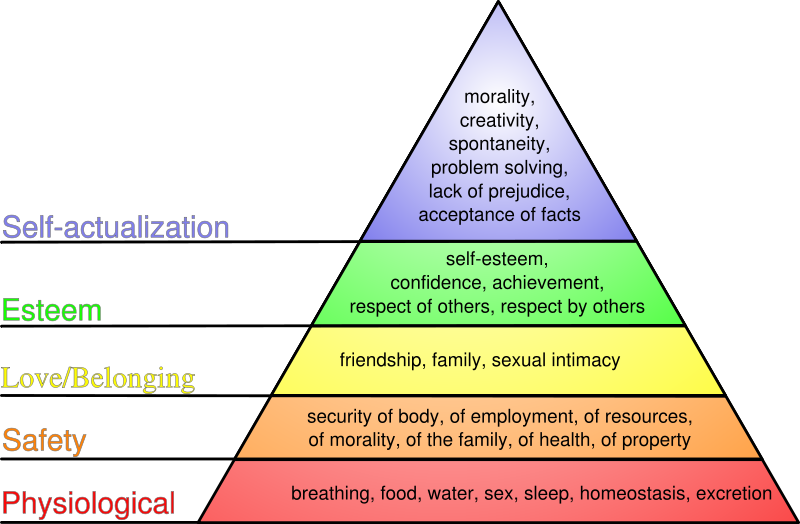
This theory suggests that we used media texts to fulfil our needs, these needs of which are based upon 'Maslow's hierarchy of needs'. This hierarchy is split into five different sections; the most important shown at the bottom being physiological needs, safety, love/belonging, esteem and at the top being the least important is self-actualization. These five are then split up into smaller needs which are met by many different aspects; some of those are then met by several media aspects.


Reception Analysis

Stuart Hall (1980)
Suggests that if you make a media piece then some meaning goes into it, when producers do this they have no control over this and how the audience are going to take this meaning of which the media piece is trying to give out. There are three different types of meaning which the audience take on;
  • Preferred Meaning- This is when the decoder is able to get the meaning of which the coder is trying to give out in the media.

  • Oppositional Reading- This is when the meaning the decoder gets from a media is opposite to the meaning that is given out by the coder. 


  • Negotiated Meaning- When the decoder gets the meaning given out by the coder but also creates their own meaning.

Open and Closed Meaning

Umberto Eco (1981)
His theory implies that the meaning given off my different types of media is split into two categories both open and closed.
  • Open- A media text with many meanings, this is deliberately ambiguous. This can be understood in different ways by a number of different audiences. 

  •  Closed- Media texts aimed at a mass audience which will be encoded in a way that most people only be able to decode the preferred meaning, the meaning that the coder wants the audience to get.


The Rule of Thirds

The Rule of Thirds


This is where the camera image or shot is devised into thirds both vertically and horizontally with imaginary lines.


Using the rule of thirds in films helps to produce an easy on the eye nice image, this is because it enables you to capture a nice balanced picture as these lines make it a lot easier to position a shot correctly.


Overall conveying that the rule of thirds is used as a guideline to create better shots and images.


Below is a image showing the rule of thirds:

Understanding Audience

Old Theories


In this lesson we were taught how to understand the concept of understanding the audience and how media texts use this, by referring to three old theories which was discussed during the lesson;


  1. Syringe Theory: This theory is where a media text is able to inject ideas straight to the audience, who will them take them in without any complaints or hesitation.
  2. Desensitisation Theory: This theory suggested that the more we see of a certain thing, then more us as an audience will feel that this is normal and acceptable. A good example of this; if audiences are watching a lot of violence the more they will feel this is normal, causing them to then also more likely to become violent.
  3. Sensitisation Theory: This theory looks at the idea that if audiences are able to see the negative effect from a bad action, the more likely they will be prevented from doing bad stuff as they will think upon the consequences of doing this themselves. For example; showing lots of blood after a shooting has been shown by the media.
Although...
These theories listed treat the audience as a mass, and think that they will all react in the same way. But this is not true for audiences today. More modern theories understand that not everyone is the same and we all have differences, therefore treat audiences more individually when creating a link between both the media text and audience.